
Business owners often ask me what actually happens once they sign up for SEO. It is a fair question. You are investing money every month, and you should know what you are paying for.
Here is how the first 90 days of a campaign work with us.
Before We Start: Access And Goals
On day one, we ask for access to your Google Search Console and Google Analytics accounts. This shows us what is already working, which pages bring in traffic and where you are losing visitors.
We also agree on clear goals. For an online shop or SaaS business, that might be sales or sign-ups from organic search. For most B2B and service businesses, it is qualified leads. For a business entering a new market, it might be traffic growth in a new region. Everything we do over the next 90 days ties back to these goals.
This is also when we learn about your business: your best services, your ideal customers and the questions they ask before they buy. That knowledge shapes every decision that follows.
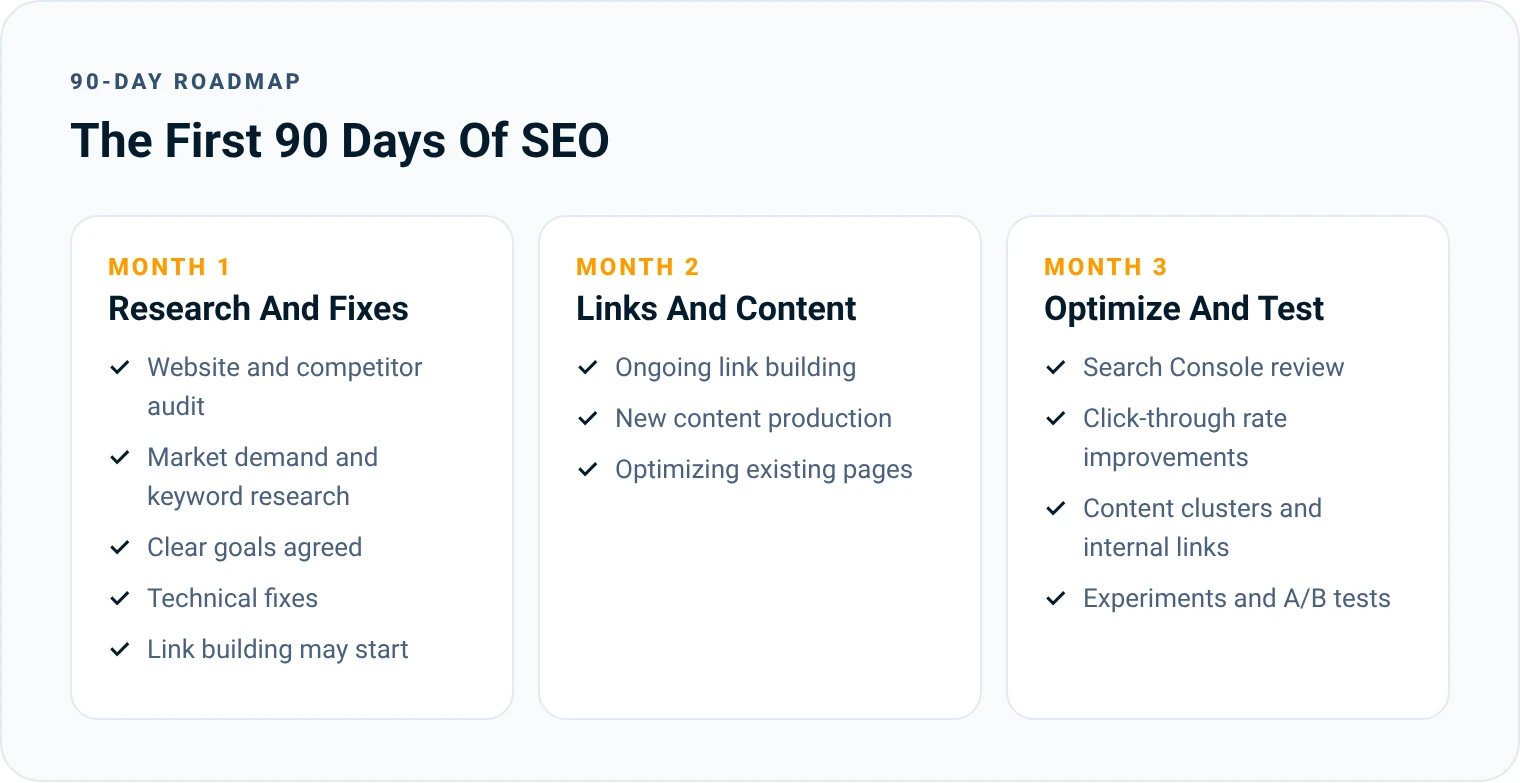
Month 1: Research, Audit And Technical Fixes
The first month is dedicated to deep research. We:
- Audit your website to find technical problems, weak pages and missed opportunities
- Analyze your competitors to see what they rank for and why
- Research market demand. Demand is the basis of a successful SEO campaign, so we look at what your buyers search for and what is worth aiming for
- Look at what already performs, so we build on your strongest pages first
- Fix the technical side so your website is in good technical health
### Why Research Comes First
It is tempting to start writing content and building links straight away. But without research, you risk targeting searches nobody makes, or searches you cannot win. A month of research means every hour and every dollar after that goes into the right place.
### The Technical Basics We Check
Technical health is the foundation for everything else. In the first month, we make sure:
- Your pages load quickly, ideally in under 2 to 3 seconds
- Your website works well on mobile, tablet and desktop
- Text is easy to read, with no contrast problems and a consistent design
- Images are optimized and have alt text
- Every page has a meta title and meta description
- Schema code is in place, so search engines and AI tools understand your pages
Link building can start towards the end of the first month.
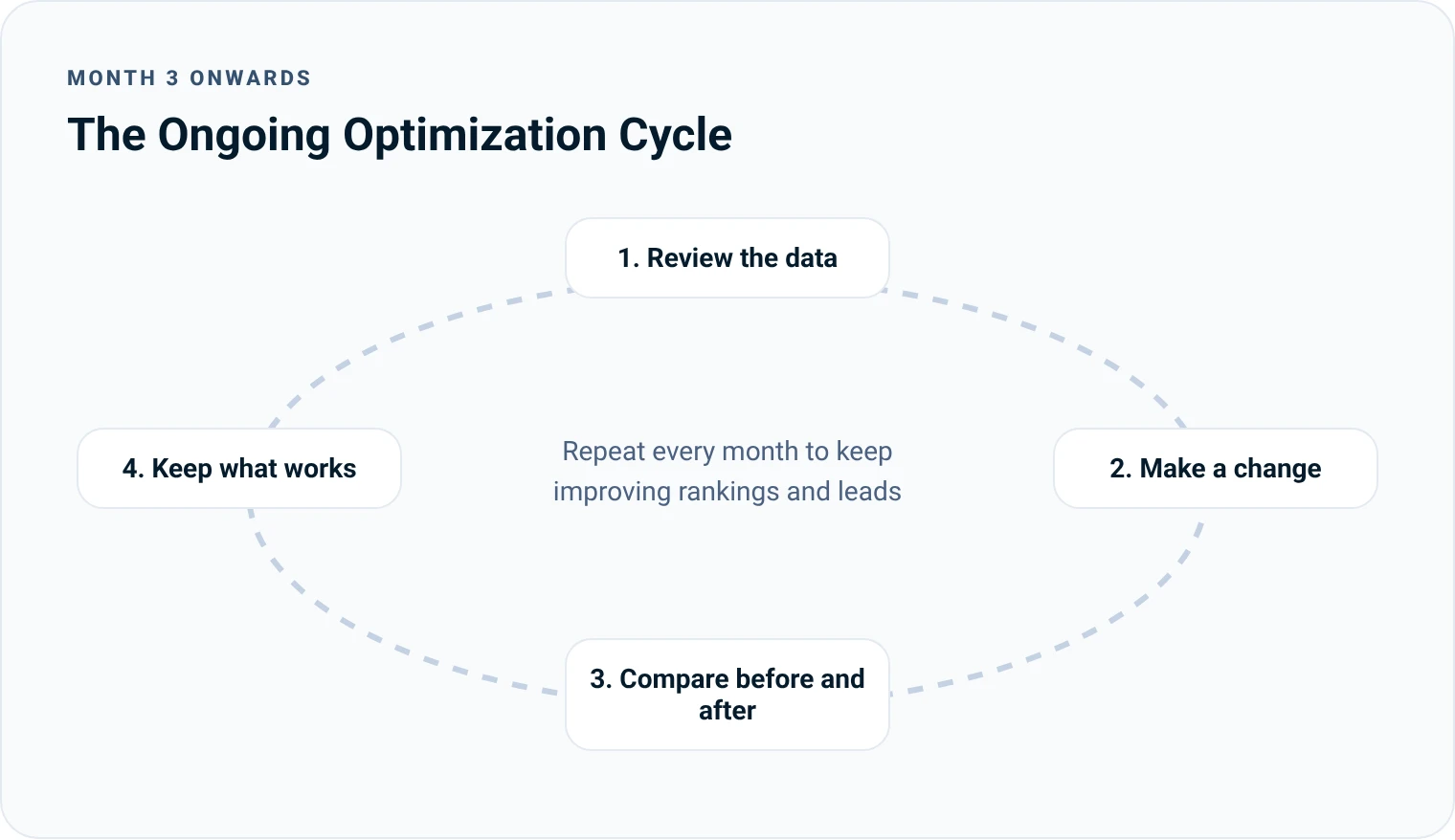
We take the first month for research: auditing your website and the competition, and analyzing market demand. Demand is really the basis of a successful SEO campaign. From then on, it becomes ongoing optimization: running experiments, monitoring the before and after of every change, and fine-tuning the website. That iterative process is what makes an SEO campaign succeed.
 Christopher LierSEO Consultant And Founder Of LinkPanda
Month 2: Links And Content
From month two, the ongoing work begins:
- Link building: A steady campaign that earns a few solid mentions on relevant websites every month.
- Content production: New pages and articles that answer your buyers' questions.
- Content optimization: Improving the pages you already have so they rank better and convert more visitors.
### What Good Link Building Looks Like
Link building is not a numbers game. We look for websites that are highly relevant to your field, with a natural mix of guest posts, listicle mentions and relevant articles. A few solid links every month build steady momentum. Large numbers of links in a short time look spammy and can turn against you.
### What Kind Of Content We Create
A good website needs a mix of content for every stage of the buying journey. That includes service pages for each thing you sell, blog posts that answer real questions with a unique angle, case studies that prove your results, and author pages that show who is behind the advice. Blog posts alone, or service pages alone, are not enough.
Month 3: Optimize, Test And Refine
From month three, SEO becomes a cycle of continuous improvement. We:
- Review your Search Console data to see which keywords are going up and which are going down
- Improve click-through rates by refining page titles and descriptions
- Keep improving your pages based on what the data shows
- Build content clusters, with main pillar pages supported by related pages
- Strengthen internal linking between your pages
- Run experiments and A/B tests, and compare the results before and after each change
This continues for as long as we work together. SEO is an iterative process, and the fine-tuning is what makes a campaign succeed.
Why We Focus On Fewer Pages First
In the first 90 days, we do not try to improve every page at once. We pick the few pages that matter most, usually your core services and the pages closest to bringing in leads, and give them the attention and the links they need.
This hyper-targeted approach gets results faster than spreading the effort thin. Once those pages perform, we widen the focus to more services, more topics and more locations.
If You Are A Local Business
For local businesses, the first month includes extra research. We look at your core services, which ones sell best and which you are most competent in. We look at your ideal customer: who has bought from you before, what type of business or person they are, and where they are located.
From there, we focus on a small number of pages built for those customers, answer the questions they ask, and make it easy to get in touch. Link building focuses on local directories, local blogs and local websites, so you leave a footprint in your area. And we make sure your Google Business Profile is accurate, with correct opening hours and contact details, recent and older photos, and a steady flow of positive reviews.
Do Not Forget Conversions
More traffic is only useful if it turns into business. With ARB Accountants, we learned that traffic alone was not enough. We had to dig into what stopped visitors from getting in touch, improve the enquiry pages and add more ways to contact the firm. That is what turned traffic into real leads.
So alongside rankings, we look at your contact forms, your calls to action and every other way a visitor can reach you.
What You Can Expect After 90 Days
After 90 days, your website should be in good technical shape, with a link building campaign running, new content live, and early movement in rankings and traffic.
The bigger results, steady leads and a clear return, usually come between 6 and 12 months. I explain why in how long SEO takes.
How We Keep You Updated
You get a monthly report, one to two strategy calls a month as needed, and a Slack channel for day-to-day communication. Every change we make is visible to you.

How You Can Help
SEO is teamwork. The campaigns that work best are the ones where the client:
- Shares knowledge about their customers, services and the questions buyers ask
- Gives quick feedback on content and new pages
- Trusts the team with day-to-day operational decisions, such as page titles, URLs and which links to build
- Avoids big, unplanned changes to the website without talking to us first
If you would like to see what the first 90 days would look like for your business, get in touch or start with an SEO audit.
Christopher Lier
Christopher has worked in SEO since 2015 and is the founder of LinkPanda, the agency behind SMESEO. He helps small and medium-sized businesses get more customers from Google and AI search.
More about Christopher