
When a business owner first talks to me about SEO, the questions are almost always the same. How soon will we get leads? How quickly will we see a return? How long do we have to commit? When will we see meaningful numbers?
Those are the right questions. They tie straight back to the goals of the business. And by "meaningful numbers" owners nearly always mean three things: leads and conversions on the website, organic traffic, and now also visibility in AI search tools such as ChatGPT.
So let me give you the honest answer I give every client, and explain what sits behind it.
The Short Answer: Plan For 6 To 12 Months
SEO is a medium to long-term channel. It is 100% possible to see some results quickly, but it is not wise to go into SEO with a short-term mindset.
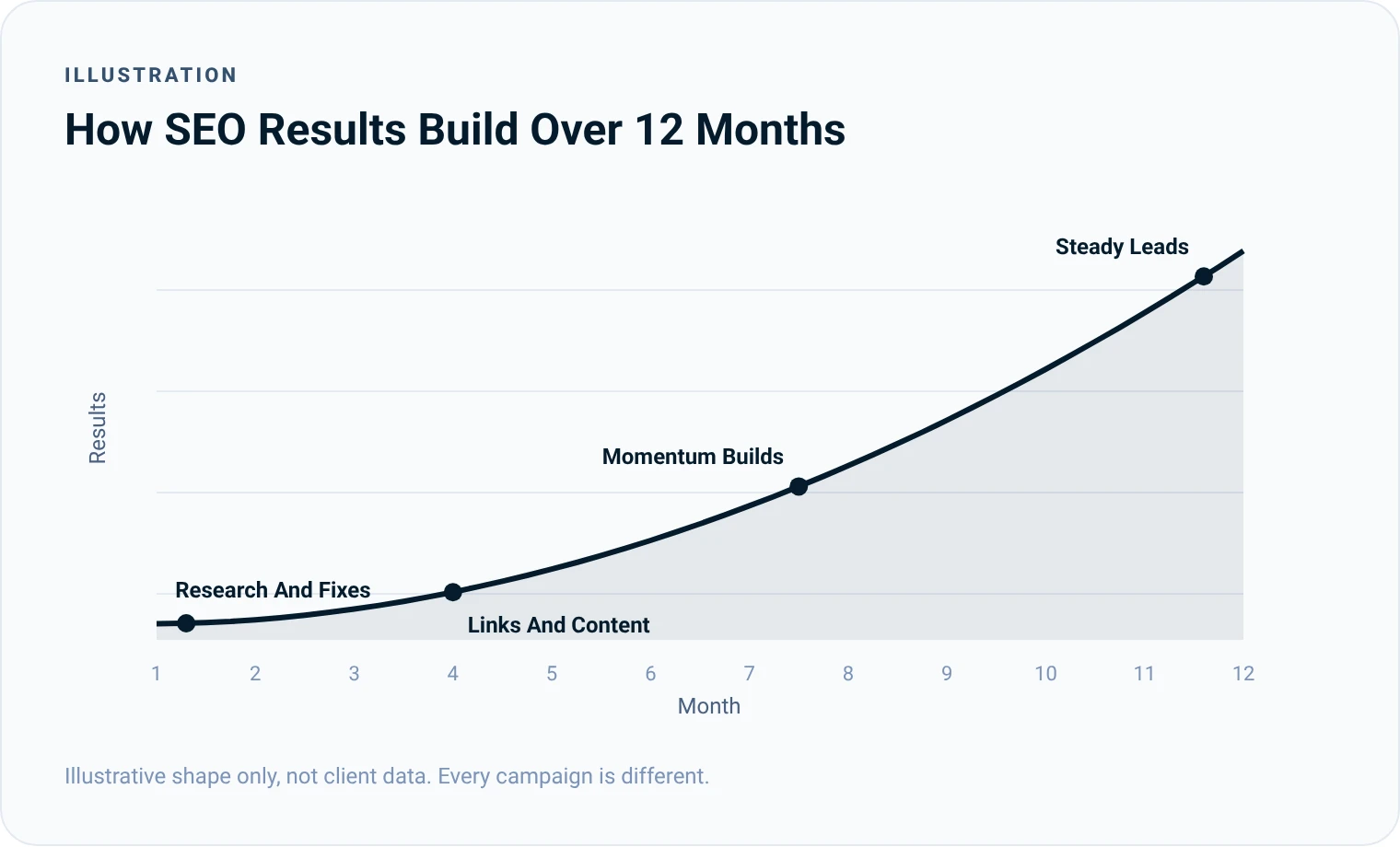
The right mindset for any meaningful SEO campaign is 6 to 12 months and beyond. That is the window in which real results show up: steady traffic, qualified leads and a return on what you invest.
SEO is won incrementally, not exponentially. It is a steady game, but if you do it right, the results last.
Why SEO Takes Time
I compare SEO to building a muscle. You do not see much after the first session at the gym, but every session builds on the last one. SEO works the same way: it builds momentum.
There are a few reasons for this:
- Trust is earned over time. Google and AI search tools favor brands that are credible and trustworthy. That reputation does not appear overnight.
- Links are built steadily. Good link building means a few solid mentions on relevant sites every month, not hundreds at once. Building too many links too fast looks spammy and can turn against you.
- Content adds up. Each useful page you publish answers more of your buyers' questions. The value grows as the library grows.
- Changes need time to be measured. We make a change, wait, measure the before and after, and then decide what to do next.
Today, search is won by brands that really are strong, not by websites that are optimized to look strong. Becoming that kind of brand online takes time, and no shortcut changes that.
SEO is a medium to long-term channel. While it is 100% possible to see results quickly, it is not advisable to have a short-term mindset. It is like building a muscle: it is building momentum. The right mindset for any meaningful SEO campaign has to be 6 to 12 months and beyond.
 Christopher LierSEO Consultant And Founder Of LinkPanda
Why Quick Results Can Be Misleading
Some changes do work quickly. Fixing a technical problem that blocked Google from your best pages, or improving a page that was already close to the first page, can show results within weeks.
That is good, but it is not the goal. A quick win on its own does not build a reliable source of leads. The businesses that win in search are the ones that keep building after the first wins, month after month.
What Happens Along The Way
SEO is not 6 months of waiting followed by a sudden jump. Work starts on day one, and you will see progress in steps:
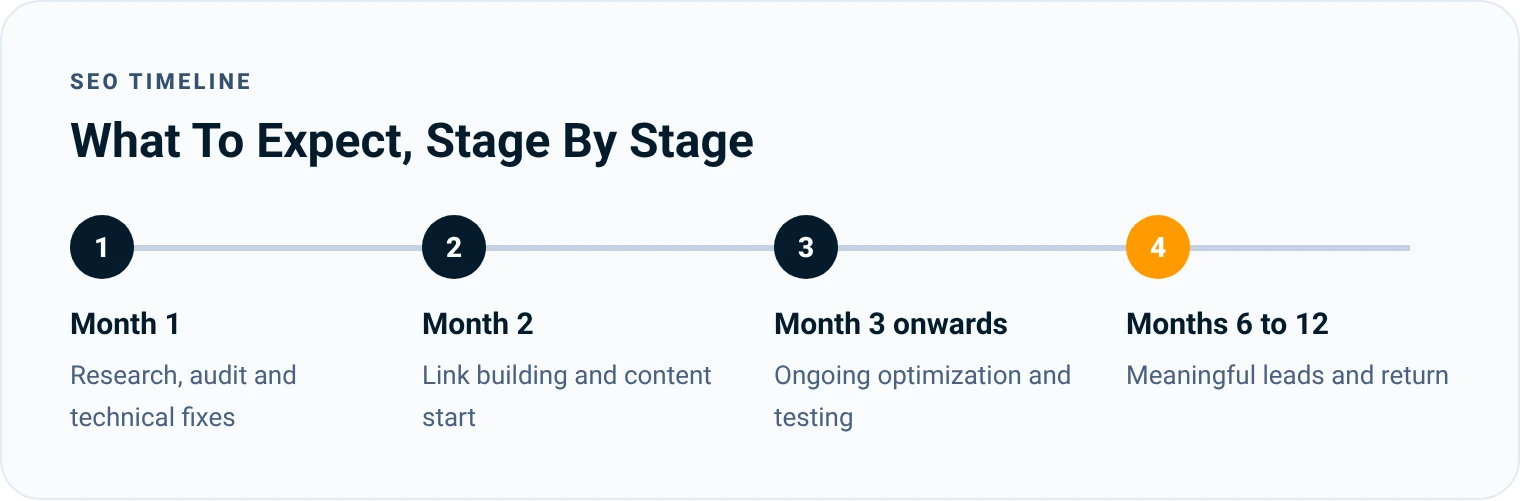
- Month 1: Research, a full audit of your website and competitors, and technical fixes.
- Month 2: Link building and content production begin.
- Month 3 onwards: Ongoing optimization based on what the data shows.
- Months 6 to 12: Meaningful leads and a measurable return.
I explain each stage in detail in the first 90 days of SEO.
What Affects How Long SEO Takes
Not every business moves at the same speed. These are the factors that make the biggest difference:
- How competitive your market is. If many strong competitors target the same searches, it takes longer to overtake them.
- The state of your website. A site with technical problems, thin pages or no clear structure needs work before it can grow.
- The resources behind the campaign. SEO needs every important area covered: technical work, content, links, reviews and case studies. A campaign that only covers one or two of these moves slowly.
- How focused you are. A business that knows exactly what it sells and who it sells to can target the right searches from the start.
- How consistent the work is. Steady content and link building every month beats bursts of activity followed by long gaps.
Focus can make a big difference, even in a crowded market. When we worked on LeadGen App, it competed in the busy online form builder market. Instead of trying to win everything, we focused on one niche, lead capture forms and multi-step forms, and built content around it. That focus made it competitive in an otherwise very competitive market.
How Long Do You Need To Commit?
I only ask clients for a minimum commitment of 3 months, occasionally 6. That is for their own peace of mind, so they know I am working in their best interest and not locking them into something long.
At the same time, I am very clear: if we do this, we have to be in it for the medium to long term, and we have to take it seriously. A 3-month commitment is a starting point, not a plan to stop after 3 months.
What Slows SEO Down
In my experience, three mistakes make SEO take longer than it should:
- Not giving it enough budget and resources. SEO needs every important area covered. If it is run on a minimal level, it never gets a fair chance. I cover this in how much SEO costs for a small business.
- Not giving it enough time. Stopping after a few months means stopping just as the momentum starts to build.
- Making erratic changes. Changing page titles, URLs or the website itself without a plan, or second-guessing every operational decision, resets the progress. Once you hire an SEO team, all changes should be visible to you, but trust them to make the day-to-day calls.
Should You Run Google Ads While You Wait?
If your business is new, ads are a quick way to get market feedback. They show you which services and messages get the most attention, and they bring in leads in a very targeted way while SEO builds up.
SEO makes more sense once you clearly know your market, your audience and your services, and you are committed to growing your website for the long term. For larger SMEs, running both is standard. Whatever you choose, both channels should be tracked clearly and be profitable.
How You Will Know It Is Working
What counts as a result depends on your business. For an online shop or a SaaS company, it might be sales and sign-ups that came directly from organic search. For most B2B and service businesses, it is the number of qualified leads coming in through the contact form and other enquiry pages. For others, it is traffic growth in a new market or region.
Whatever the goal, it should be agreed at the start, tracked every month, and tied as closely as possible to revenue and leads.
The Bottom Line
If you want SEO to bring in steady leads, plan for 6 to 12 months and beyond, give it the resources it needs, and measure it against clear goals. SEO is not a quick fix. It is an asset that keeps bringing in traffic and leads long after the work is done, and it gives you a steady source of enquiries even when demand in your market goes up and down.
If you want a realistic timeline for your own business, get in touch and we will look at your website, your market and your goals.
Christopher Lier
Christopher has worked in SEO since 2015 and is the founder of LinkPanda, the agency behind SMESEO. He helps small and medium-sized businesses get more customers from Google and AI search.
More about Christopher