
AI search has changed how people find businesses. A growing share of research, and more and more buying decisions, now happen in ChatGPT and other AI tools. This is true across consumer and business-to-business industries.
These tools filter out the noise and answer any question a buyer has. If your business does not show up in those answers, a competitor will. So whatever industry you are in, you need a plan for AI search.
What It Takes To Be Competitive In AI Search
Being competitive in AI search means three things:
- Being visible: Your business is mentioned when buyers ask about your type of product or service.
- Positive sentiment: What is said about your brand online is positive.
- Being clearly understood: The AI tool knows exactly what you offer and who it is for.
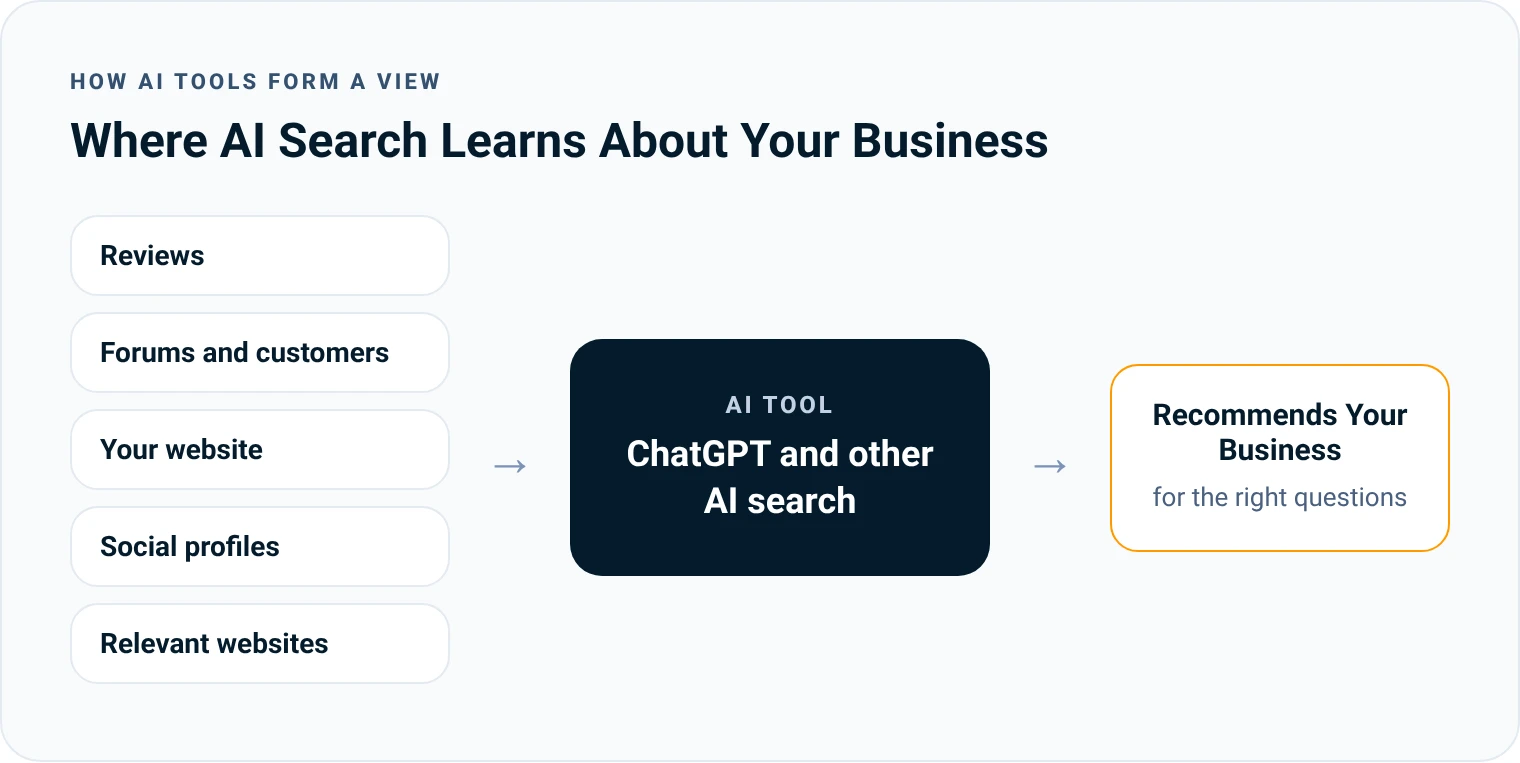
AI tools build their view of your business from many places, not just your website. Reviews, forums, social profiles and other websites all feed into the answer a buyer sees.
Here is how to get there.
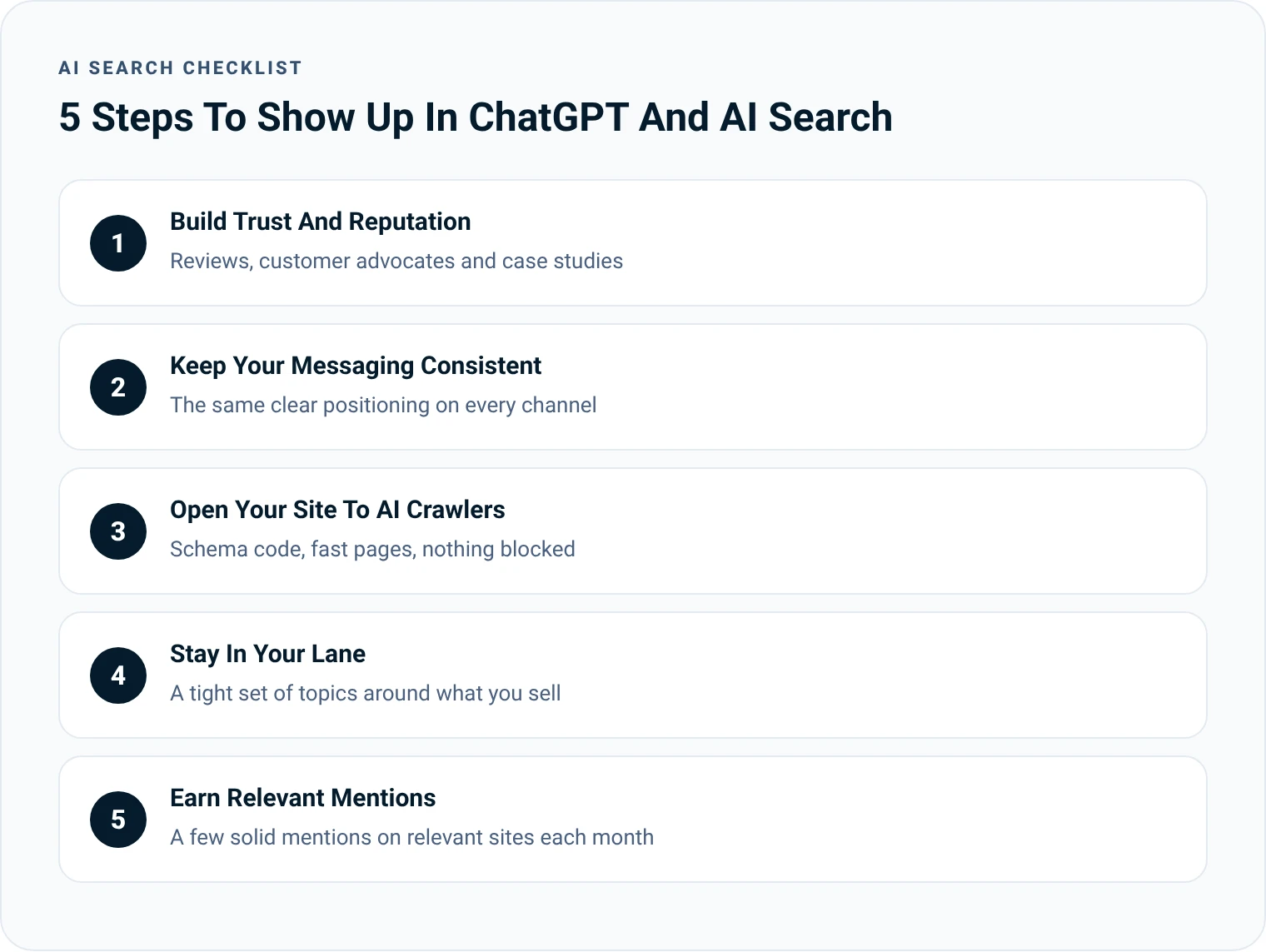
1. Build Trust And Reputation
Trust and reputation matter more than ever. AI tools look at what other people say about you, not only what you say about yourself.
- Get your reviews in shape. A credible, steady flow of positive reviews is one of the strongest signals you can send. Ask happy customers to leave a review, and reply to the reviews you get.
- Build advocates. Customers who talk about you in forums, on social media and in communities show that your company is credible.
- Publish case studies. For B2B and service businesses, real results prove what you do.
A business with a strong reputation is easy for an AI tool to recommend. A business with few reviews and little proof is a risk, so it is less likely to be mentioned.
AI tools are there to provide answers, to filter out the noise and to directly answer any question a buyer has. That tells us a business has to be competitive on those platforms. Trust has become more important, reputation has become more important, and over time it is all about consistent trust building, a clear value proposition and staying in your lane.
 Christopher LierSEO Consultant And Founder Of LinkPanda
2. Keep Your Messaging Consistent Everywhere
Your website, social media profiles, directory listings and any other place your business appears should all say the same thing. Do not let each channel work on its own.
Clear, consistent positioning on every platform means an AI tool can understand what your company stands for, without confusion. If your website says one thing, your LinkedIn page says another and an old directory listing says something else, the AI tool has to guess. Make it easy by saying the same thing everywhere.
A good test is to write one sentence that explains who you help and what you do. Then check that every profile and listing matches it.
3. Make Your Website Easy For AI Tools To Read
The technical side matters too:
- Keep your website open to crawlers, AI agents and bots. Do not block them by accident. Some security settings and plugins block these tools without you knowing.
- Add schema code. Structured data helps machines understand your pages: who you are, what you sell, your reviews and your FAQs.
- Consider simple text versions of key pages written for AI agents.
- Make your website fast. Pages should load in under 2 to 3 seconds.
These are small technical steps, but they make a big difference to how easily AI tools can read and trust your website.
4. Stay In Your Lane
Keep your website focused on what you actually do. A lean, tight set of topics is better than trying to cover everything. When your website clearly says "this is exactly what we offer", an AI tool can recommend you for the right questions to the right buyers.
One of our own projects shows how well this works. LeadGen App competed in the crowded online form builder market. Instead of trying to win everything, we focused on one niche, lead capture forms and multi-step forms, and built lots of content around it. That focus made the brand competitive in an otherwise very competitive market.
5. Earn Mentions On Relevant Websites
Backlinks and brand mentions are still the fuel for search, for Google and for AI tools. Be selective:
- Get featured on websites that are highly relevant to your field.
- Keep it natural, with a mix of guest posts, listicle mentions, podcasts and relevant articles.
- Avoid stuffing exact keywords into your link text.
- Aim for a few solid mentions every month, not large numbers at once.
Link building is not a numbers game. Too many links too fast looks spammy and can turn against you. A steady flow of relevant mentions builds the kind of reputation AI tools trust.
Create Content AI Tools Cannot Write Themselves
AI tools can already answer basic questions. If your blog only repeats what everyone else says, it adds nothing new, and there is no reason for an AI tool to point to you.
The content that works is content with a unique angle: your own experience, your own results, your own way of solving a problem. Add author pages with real bios and credentials, publish case studies, and consider useful tools such as calculators. This is the kind of content that builds trust with buyers and gives AI tools a reason to mention your business.

Local Businesses And AI Search
If your customers come from a local area, the same principles apply, with a few extra steps. Many AI tools draw on local business information, so make sure your Google Business Profile is accurate and complete:
- Correct opening hours, phone number and email address
- Recent photos, and older photos too, because they show you have been in business for years
- A steady flow of positive reviews
Then build a footprint in your area. Get listed in local directories, and look for mentions on local blogs and local websites. When an AI tool sees the same accurate details about your business in many trusted local places, it can recommend you with confidence to people nearby.
How To Check How AI Tools See Your Business
A simple way to start is to ask ChatGPT and other AI tools the questions your buyers ask. Ask which companies they recommend for your service in your area or industry, and ask what they know about your business.
Note whether you are mentioned, what is said about you, and which competitors appear instead. Repeat this every few months to see how your visibility changes.
How Long Does It Take?
AI visibility builds the same way SEO does: steadily. Reputation, reviews and mentions grow over months, not days. Plan for the same 6 to 12 month mindset you would for any serious SEO campaign.
Be A Strong Brand, Not Just Look Like One
The biggest lesson I have learned in more than 10 years of SEO is this: quick tricks no longer work. Search engines and AI tools reward businesses that really are strong brands, not businesses that only try to look like one.
So the long-term strategy for AI search is simple to say and hard to do: build trust consistently, have a clear value proposition, and stay focused on what you do best.
If you want to know how your business shows up in AI search today, get in touch and we will take a look. You can also see how we approach AI search as part of our SEO services.
Christopher Lier
Christopher has worked in SEO since 2015 and is the founder of LinkPanda, the agency behind SMESEO. He helps small and medium-sized businesses get more customers from Google and AI search.
More about Christopher