
Most small business owners know SEO matters, but few know where to start. Advice online is either too basic to help or so technical that it puts people off.
This checklist sits in the middle. It covers the steps that make a real difference for small and medium-sized businesses, grouped into six areas, with a clear order to work through them. You can tick off many of the items in an afternoon. Others are ongoing work you repeat every month.
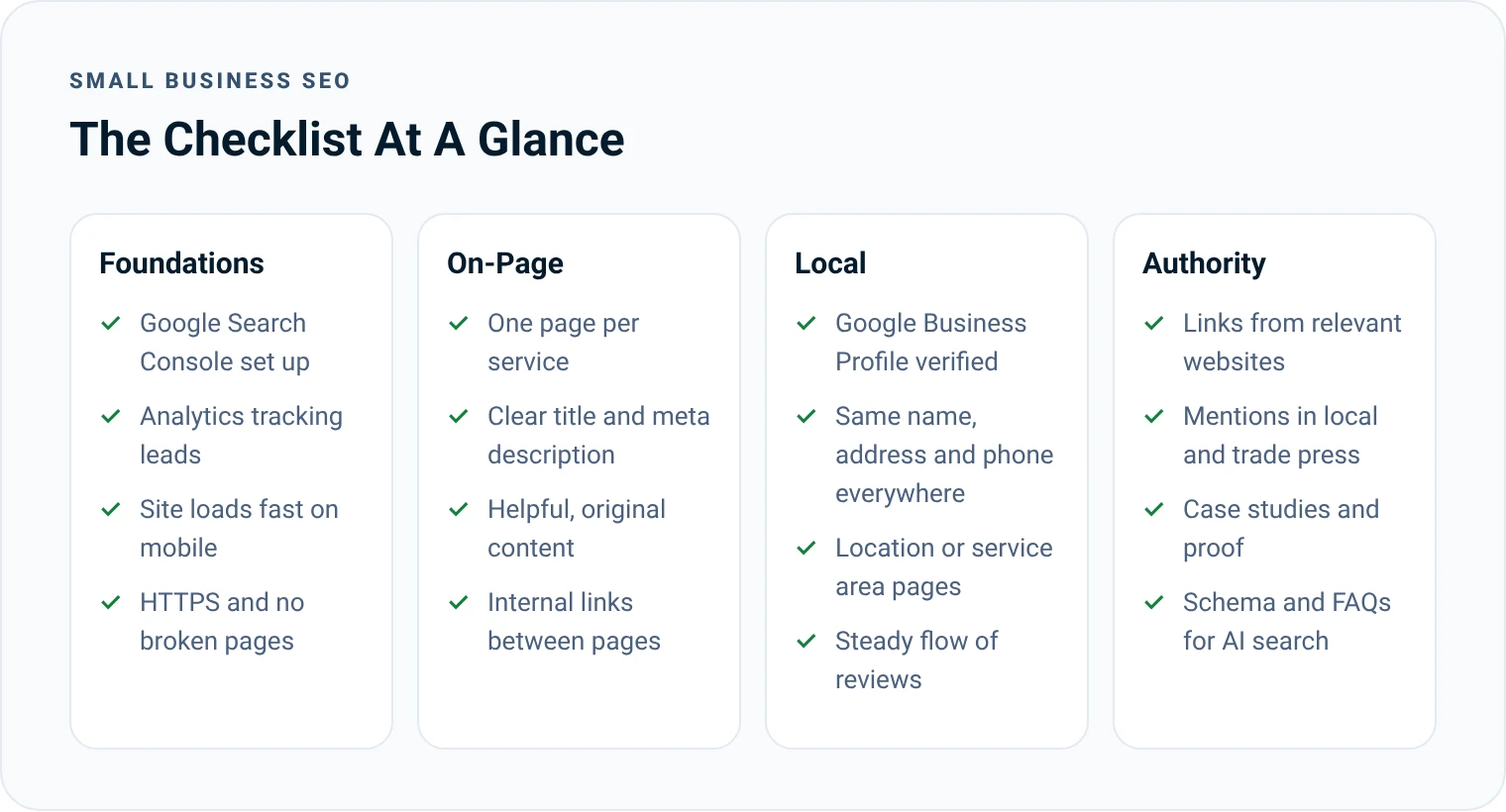
1. Set Up The Foundations
Before you change anything, make sure you can measure what happens. Without tracking, you cannot tell which changes work.
- Set up Google Search Console. It shows which searches your site appears for, how many clicks you get and any problems Google finds.
- Set up analytics. Google Analytics or a similar tool shows how many people visit and what they do.
- Track leads, not just visits. Count form submissions, calls and bookings as conversions, so you can see which pages bring in customers.
- Check your site works on HTTPS. The padlock in the browser bar should show on every page.
- Make sure Google can index your site. In Search Console, check that your important pages are indexed and nothing is blocked by mistake.
- Submit an XML sitemap. Most website platforms create one for you. Add it in Search Console.
2. Fix The Technical Basics
Technical SEO sounds complex, but for most small business websites a few checks cover the main risks.
- Test your speed on mobile. Most local searches happen on phones. Google's PageSpeed Insights tool shows what slows your pages down, and large images are the usual cause.
- Fix broken pages and links. Pages that return errors waste visits and send poor signals. Redirect old URLs to the closest live page.
- Use one version of your domain. Your site should load on one address, with or without www, and redirect the other.
- Keep your structure simple. Every important page should be reachable within a few clicks from the homepage.
- Do not block crawlers. Search engines and AI tools need to reach your pages to show them. Keep access open unless you have a clear reason not to.
3. Get Your On-Page SEO Right
On-page SEO is how each page tells search engines and visitors what it is about. This is where many small businesses gain the most, because the work is simple and the results can show quickly.
- Create one page per service. A single "Services" page cannot rank for ten different searches. Give each main service its own page.
- Write a clear title for each page. Include the main search term and your brand, for example "Boiler Repair In Leeds | Smith Heating".
- Write a meta description for each page. Start with the search term and explain in one or two sentences why someone should click.
- Use one H1 per page. It should say plainly what the page covers.
- Answer real questions. Add the questions customers ask you on the phone, with short, direct answers.
- Link your pages together. Link from your homepage and blog posts to your service pages, using descriptive link text.
- Add alt text to images. Describe what each image shows in a few words.
To bring in traffic that turns into leads, you have to cover every main area of SEO. There should be no weak areas, especially now that AI tools decide which businesses they recommend.
 Christopher LierSEO Consultant And Founder Of LinkPanda
4. Win In Local Search
If your customers are in a town, city or region, local SEO is often the fastest way to more enquiries. Google shows a map with three businesses at the top of many local searches, and those three get a large share of the calls.
- Claim and verify your Google Business Profile. Our guide on how to create a Google Business Profile walks through each step.
- Choose the right categories. Your primary category matters most. Pick the one that best describes your main service.
- Complete every section. Add your hours, services, photos and a description.
- Keep your name, address and phone number the same everywhere. Your website, your profile and directory listings should match exactly.
- Create location or service area pages. If you cover several towns, a useful page for each one helps you rank beyond your own postcode.
- Ask every happy customer for a review. A steady flow of recent reviews builds trust with both people and search engines. Reply to every review, good or bad.

5. Publish Helpful Content
Content is how you rank for the questions people ask before they buy. It is also how you show expertise, which matters more every year.
- List the questions customers ask. Your sales calls and emails are the best source of topics.
- Write one helpful guide or article a month. Quality beats volume. One clear, useful post is worth more than four thin ones.
- Add case studies. Real projects with real results prove you can do the work. For B2B and service businesses they are some of the most persuasive pages on the site.
- Show who wrote it. Add an author name and a short bio, especially for advice on money, health or law.
- Update old content. Refresh prices, dates and facts at least once a year.
6. Build Authority And Trust
Search engines and AI tools favour businesses that other people trust. Links and mentions from relevant websites are still one of the strongest signals.
- Earn links from relevant websites. Trade associations, suppliers, local news sites and industry blogs are good places to start.
- Get listed in trusted directories. Choose a handful of directories that matter in your industry and your country.
- Keep link building steady. A few good links every month work better than a large batch at once.
- Add schema markup. Structured data for your business, services, reviews and FAQs helps search engines and AI tools understand your pages.
- Keep your message consistent. Describe what you do in the same way on your website, profiles and social channels, so AI tools are clear about what you offer.
The Order To Work Through It
You do not need to do everything at once. Start with the items that unblock everything else, then build the habits that keep results growing.
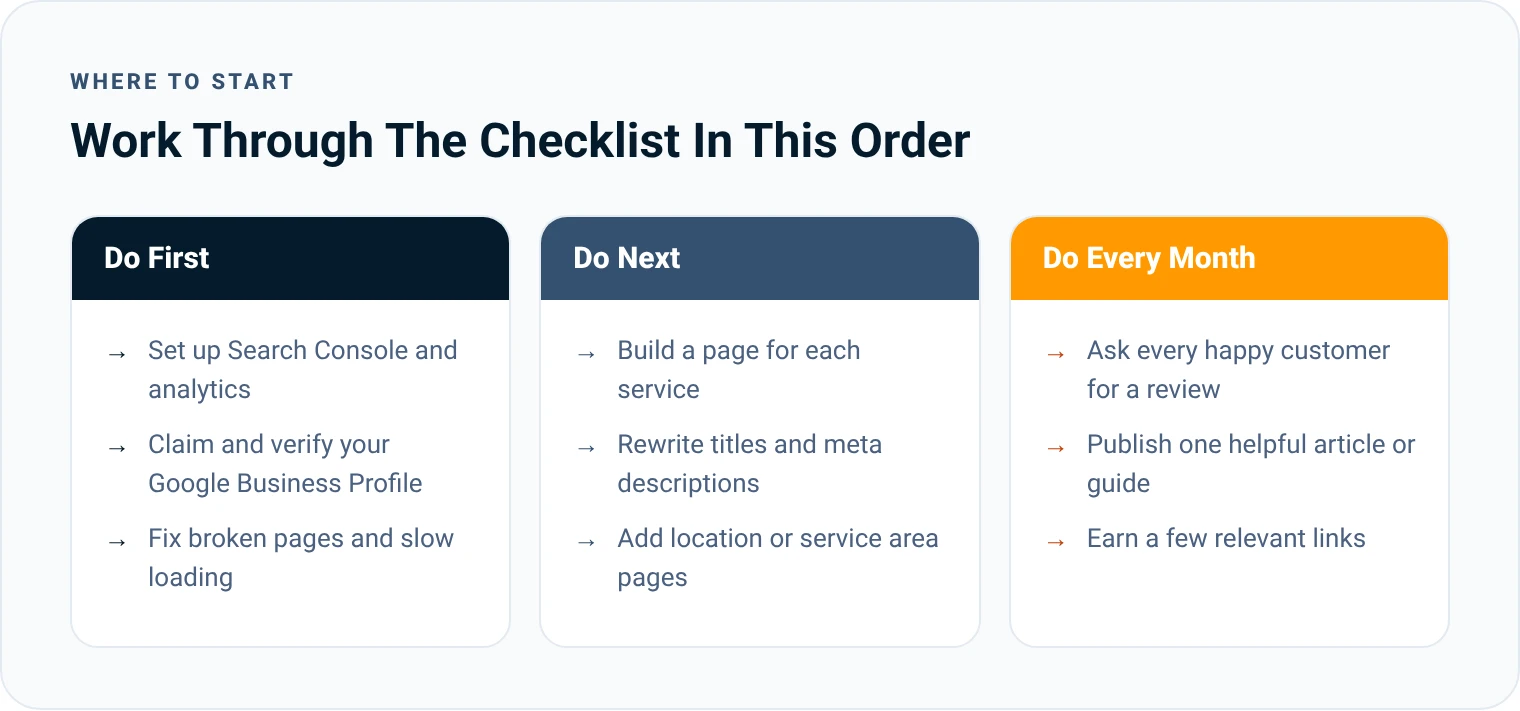
- Week 1: Set up Search Console and analytics, claim your Google Business Profile, and fix any broken pages.
- Weeks 2 to 4: Build or improve one page per service, and rewrite titles and meta descriptions.
- Month 2 onwards: Add location pages, collect reviews every week, publish one helpful article a month and earn a few relevant links.
When A Checklist Is Not Enough
A checklist gets the basics right. In competitive markets, the basics are only the starting point. Your competitors have the same checklist, and the businesses at the top usually invest in content, links and technical work every month.
If your rankings have stalled, or you do not have the time to keep up the monthly work, that is when an SEO specialist or agency helps. Our guide on what an SEO agency does explains what that support looks like, and our SEO audit gives you a ranked list of fixes for your own website.
The most important thing is to start. Tick off the foundations this week, then add one or two steps every month. SEO rewards steady effort more than quick bursts.
Christopher Lier
Christopher has worked in SEO since 2015 and is the founder of LinkPanda, the agency behind SMESEO. He helps small and medium-sized businesses get more customers from Google and AI search.
More about Christopher